
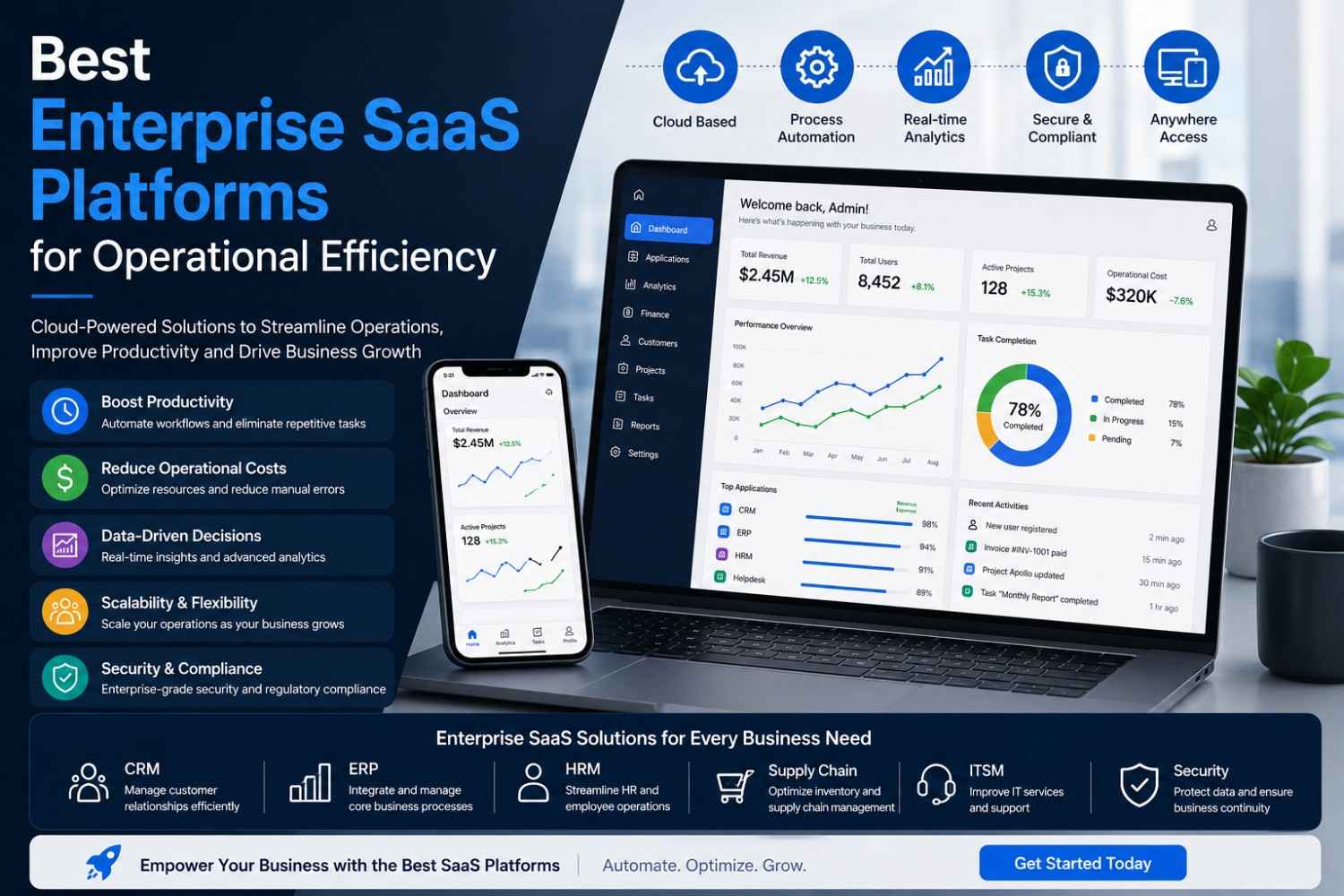
Organizations today face increasing pressure to improve productivity, reduce operating costs, and scale operations efficiently. Traditional on-premise software systems often create challenges related to maintenance, integration, and scalability.
Enterprise SaaS platforms have emerged as the preferred solution for businesses seeking operational efficiency and digital transformation.
Modern SaaS platforms provide cloud-based access to critical business functions, including workflow automation, financial management, customer relationship management, business intelligence, compliance management, and enterprise collaboration.
For companies across the United States, Canada, the United Kingdom, Germany, Australia, Switzerland, and other developed markets, enterprise SaaS software has become a key driver of business growth and competitive advantage.
What Are Enterprise SaaS Platforms?
Enterprise SaaS (Software as a Service) platforms are cloud-based software solutions delivered through the internet. Unlike traditional software installations, SaaS applications are hosted by vendors and accessed through web browsers.
Enterprise SaaS platforms commonly support:
- Workflow automation
- Customer relationship management (CRM)
- Enterprise resource planning (ERP)
- Financial management
- Business intelligence
- Human resource management
- Compliance tracking
- Collaboration tools
This model enables organizations to access powerful software without maintaining complex infrastructure.
Why Enterprises Are Adopting SaaS Platforms
Organizations want lower IT costs, faster deployment, better scalability, enhanced security, improved collaboration, and continuous innovation. Cloud-based enterprise software provides the flexibility that traditional systems often cannot match.
Key Benefits of Enterprise SaaS Platforms
1. Lower Infrastructure Costs
SaaS platforms eliminate the need for expensive servers, hardware investments, and ongoing IT maintenance.
2. Improved Operational Efficiency
Streamlined operations through workflow automation, process standardization, centralized data management, and real-time reporting.
3. Better Scalability
Organizations can quickly add users, expand functionality, scale globally, and support remote teams.
4. Enhanced Business Visibility
Integrated business intelligence software provides real-time dashboards, performance monitoring, data analytics, and KPI tracking.
Essential Features of Enterprise SaaS Platforms
Workflow Automation
Automate repetitive tasks such as approval workflows, document routing, customer onboarding, and procurement management.
Business Process Automation
Streamline end-to-end operations with reduced processing times, improved accuracy, and better compliance.
Data Analytics and Reporting
Includes data analytics platforms, custom reporting tools, executive dashboards, and predictive analytics.
Compliance Management
Helps organizations meet financial regulations, data privacy requirements, and internal governance policies.
AI-Powered SaaS Platforms
Artificial intelligence helps automate workflows, analyze data, forecast outcomes, detect anomalies, and improve customer experiences.
Enterprise SaaS and Digital Transformation
SaaS platforms support digital transformation through cloud adoption, process automation, AI integration, data centralization, and remote collaboration.
How to Choose the Best Enterprise SaaS Platform
Organizations should evaluate integration capabilities, security features, scalability, and vendor support before making a decision.
SaaS Trends for 2026
- AI-Driven Automation
- Hyperautomation (AI + RPA + Machine Learning)
- Predictive Analytics
- Industry-Specific SaaS Solutions
Frequently Asked Questions
What is an enterprise SaaS platform?
An enterprise SaaS platform is a cloud-based software solution that helps organizations manage business operations through subscription-based services.
Why are SaaS platforms popular?
SaaS platforms offer lower costs, faster deployment, scalability, and easier maintenance compared to traditional software.
Are SaaS platforms secure?
Most enterprise SaaS vendors provide advanced security features, compliance certifications, encryption, and access controls.
Conclusion
Enterprise SaaS platforms have become essential for organizations seeking greater operational efficiency, scalability, and business agility.
By combining workflow automation, business intelligence, financial management, compliance software, enterprise risk management, and AI-powered analytics, SaaS platforms help businesses optimize operations and accelerate digital transformation.
As enterprises continue investing in cloud-based technologies, SaaS solutions will remain a critical component of business success throughout 2026 and beyond.