
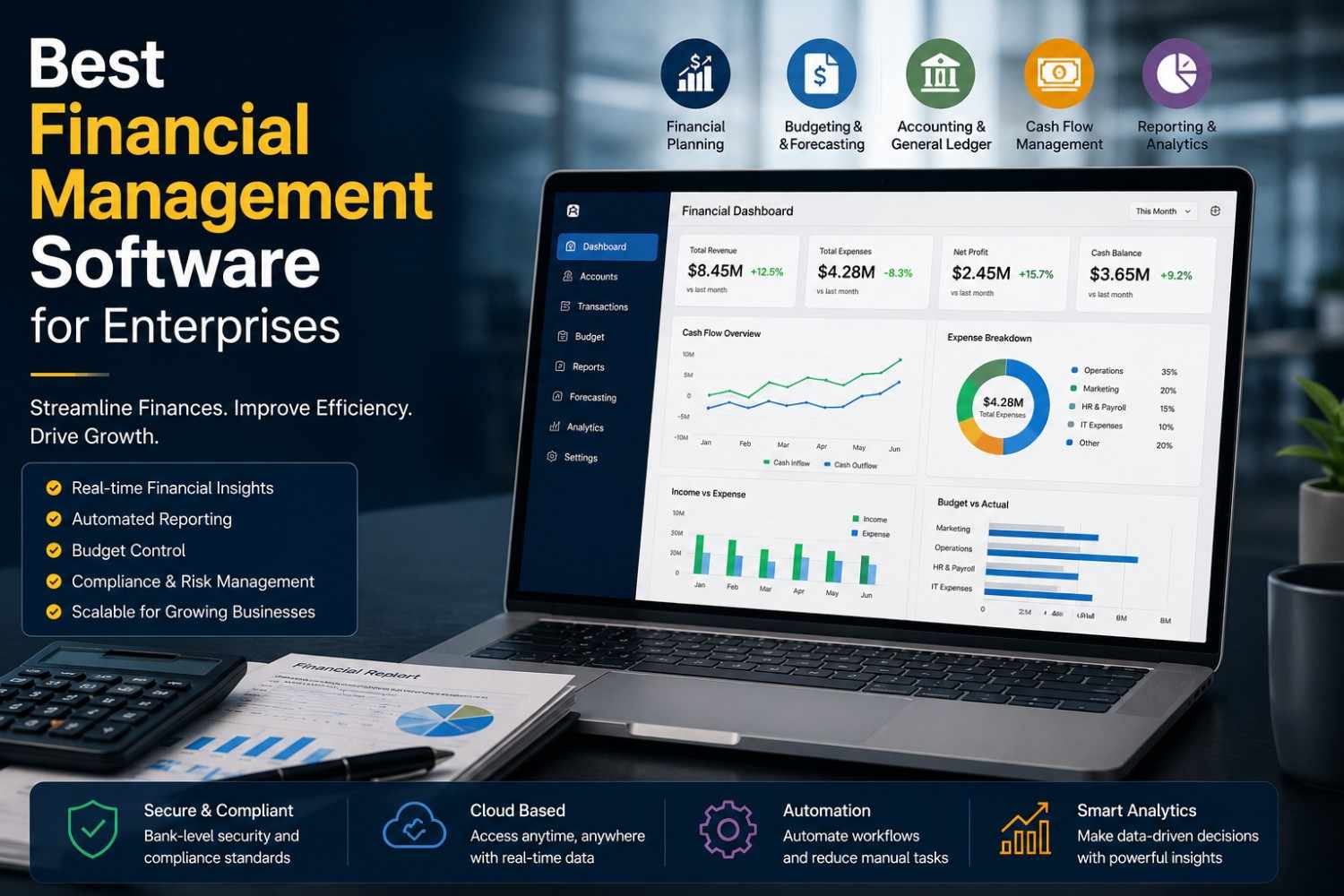
Modern enterprises generate enormous amounts of financial data every day. Managing budgets, forecasting revenue, controlling expenses, maintaining compliance, and producing accurate reports have become increasingly complex.
Traditional accounting systems often struggle to meet the needs of growing organizations. As businesses expand, finance teams require more sophisticated tools that provide real-time visibility and automation.
Financial Management Software helps enterprises streamline financial operations, improve reporting accuracy, enhance compliance, and support strategic decision-making.
In 2026, organizations are increasingly adopting cloud-based financial management platforms to improve efficiency, reduce manual work, and gain better control over corporate finances.
What Is Financial Management Software?
Financial Management Software is a centralized platform that helps organizations manage financial activities across departments.
The software typically supports:
- Financial planning
- Budget management
- Cash flow tracking
- Expense management
- Revenue forecasting
- Financial reporting
- Compliance monitoring
- Risk management
Instead of relying on disconnected spreadsheets and manual processes, enterprises can manage financial operations through a single integrated platform.
Why Enterprises Need Financial Management Software
Large organizations face multiple financial challenges, including inaccurate reporting, delayed insights, compliance risks, and inefficient budgeting. Enterprise finance software addresses these issues through automation and real-time intelligence.
Key Benefits of Financial Management Software
1. Improved Financial Visibility
Finance leaders can monitor revenue performance, operational expenses, department budgets, cash flow, and key financial KPIs through real-time dashboards.
2. Automated Financial Processes
Workflow automation streamlines invoice approvals, expense management, payment processing, budget reviews, and financial reporting.
3. Better Budgeting and Forecasting
Modern platforms offer scenario modeling, budget forecasting, revenue projections, and cost analysis for proactive financial planning.
4. Stronger Compliance Management
Built-in tools help maintain audit trails, monitor controls, generate compliance reports, and improve governance.
Essential Features to Look For
Financial Planning and Analysis (FPA)
Budget management, revenue forecasting, scenario planning, and profitability analysis.
Financial Reporting
Real-time dashboards, automated reporting, KPI tracking, and custom reports.
Expense Management
Expense tracking, approval workflows, policy enforcement, and reimbursement management.
Cash Flow Management
Cash flow forecasting, liquidity monitoring, working capital analysis, and financial risk assessment.
Cloud-Based Financial Management Software
Cloud-based solutions offer lower infrastructure costs, real-time access, scalability, and automatic updates, making them the preferred choice for modern enterprises.
AI and Automation in Financial Management
AI-powered tools automate invoice processing, data entry, fraud detection, forecasting, and risk analysis, significantly improving productivity and accuracy.
Financial Management and Business Intelligence
Integration with Business Intelligence Software helps identify spending trends, analyze profitability, track KPIs, and improve forecasting accuracy.
How to Choose the Right Financial Management Software
Enterprises should evaluate scalability, integration capabilities (ERP, CRM, Payroll), security features, and reporting functionality before making a decision.
Financial Management Software Trends for 2026
- AI-Powered Forecasting
- Predictive Analytics
- Increased Automation
- ESG and Sustainability Reporting
Frequently Asked Questions
What is financial management software?
Financial management software helps organizations manage budgeting, forecasting, reporting, compliance, cash flow, and financial operations.
Why do enterprises use financial management software?
Enterprises use these platforms to improve financial visibility, automate processes, strengthen compliance, and support strategic decision-making.
Is cloud-based financial software secure?
Yes. Most leading platforms provide enterprise-grade security, encryption, access controls, and compliance certifications.
Conclusion
Financial Management Software has become a critical technology for enterprises seeking greater visibility, operational efficiency, and financial control.
Modern platforms combine financial planning, reporting, automation, compliance management, predictive analytics, and business intelligence into a unified solution.
As enterprises continue investing in digital transformation initiatives, cloud-based financial management software will play an increasingly important role in driving growth, improving decision-making, and supporting long-term business success throughout 2026 and beyond.